




• admindesk@icoyacaafrica.org
News Photo

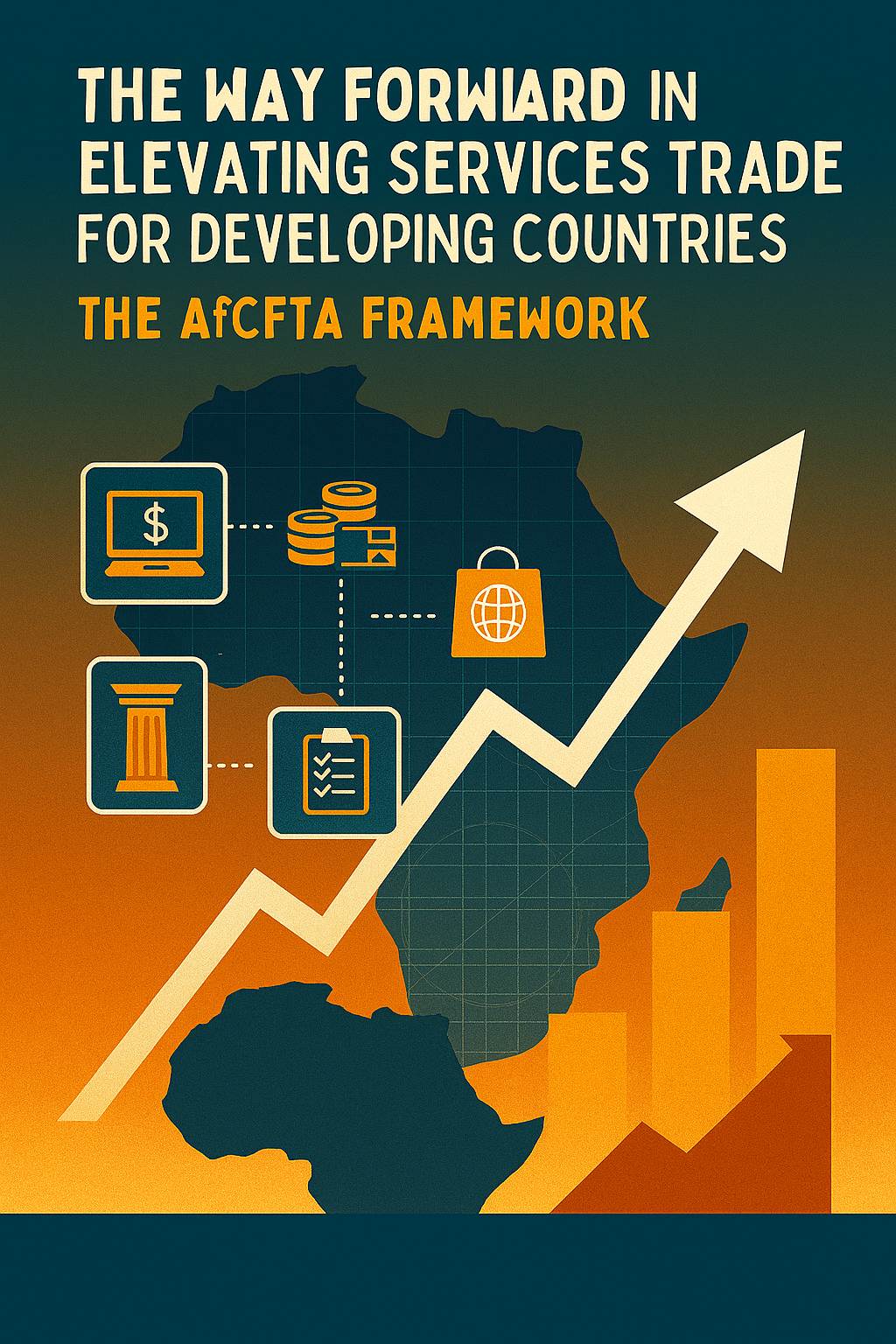
Elevating Services Trade for Developing Countries: The AfCFTA Framework

  • Blog
  • December 04, 2025

The 21st-century economy is fundamentally defined by services. For developing countries, services are not merely a sector but the indispensable lubricant for economic diversification, industrialization, and value addition. This is acutely true for Africa, where the potential for intra-continental services trade from finance and telecommunications to transport and tourism remains largely untapped, constrained by regulatory fragmentation and infrastructural deficits.

The African Continental Free Trade Area (AfCFTA) represents a monumental leap forward. More than just a pact for goods, its success hinges on the liberalization of services. The Protocol on Trade in Services within the AfCFTA provides a visionary framework, capable of transforming Africa’s economic landscape by creating a single, integrated services market. The imperative now is to translate this legal framework into a tangible, on-the-ground economic reality.

What is Services Trade and Why is it Relevant?

Services trade refers to the cross-border delivery of intangible economic activities that support global commerce and human development. These activities are broad, ranging from essential backbone services like global logistics, transportation, and communications, to highly specialized inputs such as professional, financial, architectural, and engineering services, which shape infrastructure and underpin all other economic sectors.The ability to "trade" these services is rapidly expanding due to technological advancements. Faster communication networks and new digital platforms enable services—like knowledge, design, and specialized content—to be offered remotely to customers across the globe, transcending geographical limitations.

The Importance of Improving Services Trade Policies

Improving policies related to services trade is critical because open, competitive, and effectively regulated services markets are fundamental accelerators for modern economies. They foster environments that are stronger, more sustainable ("greener"), and more technologically integrated ("digital").

As noted by Janos Ferencz, Trade Policy Analyst at the OECD, a strategic focus on services trade policies is essential for navigating the complex activities that make up this sector, ultimately driving a more efficient and productive global economic system. Reforming services trade ensures that consumers have access to better quality services at lower prices. Furthermore, optimizing services trade helps increase domestic productivity and economic performance. With contemporary manufacturing increasingly reliant on sophisticated services inputs, competitiveness depends on access to state-of-the-art suppliers at the best price.

The AfCFTA Mandate: Unlocking Intra-African Potential

The AfCFTA Protocol on Trade in Services aims to eliminate barriers to cross-border service supply (across Modes 1, 2, 3, and 4), thereby creating efficiency, stimulating investment, and allowing African firms to scale continentally before competing globally. The initial commitments cover five priority sectors: Transport, Communication, Financial Services, Tourism, and Business Services.

The promise of this liberalization is immense: imagine a Ghanaian insurance firm effortlessly serving clients in Kenya, or a South African logistics provider running seamless trucking operations across all 54 signatory states. Achieving this requires addressing fundamental challenges and embracing four strategic pillars for the way forward.

Strategic Pillars for Elevating Services Trade

1. The Digital Infrastructure and Regulatory Harmonization

Services trade today is digital trade. The ability of African MSMEs to export high-value services (Mode 1: cross-border supply) depends entirely on reliable, affordable broadband and, critically, predictable regulatory environments.

  • Harmonizing E-Commerce and Data Rules: AfCFTA must prioritize the conclusion and implementation of a robust e-commerce protocol that sets common standards for data governance, cross-border data flows, and consumer protection. Fragmentation, such as varying data localization requirements across 54 states, is economically paralyzing for tech start-ups and digital service providers.

  • Digital Single Market: Focusing on shared digital infrastructure—from regional payment gateways to secure digital identity verification—will reduce friction and transaction costs for services exports across the continent.

2. Facilitating Human Capital Mobility (Mode 4)

The free movement of natural persons (Mode 4) is arguably the most critical component for services trade growth, particularly in sectors like professional services, education, and healthcare. African expertise must be able to move where it is most needed.

  • Mutual Recognition Agreements (MRAs): Member states must accelerate negotiations for MRAs across all committed sectors (e.g., engineering, accounting, legal services). These agreements ensure that professional qualifications obtained in one member state are recognized in another, dismantling non-tariff barriers that currently hinder the mobility of talent.

  • Harmonized Visa Regimes: Simplifying and standardizing work permits and temporary entry visas for service suppliers will inject dynamism into the regional labor market, allowing firms to deploy specialized expertise quickly and efficiently.

3. Sectoral Deepening and Prioritization

While the initial five sectors are foundational, AfCFTA members must move towards deep integration in high-potential areas that drive value-chain participation:

  • Financial Services: Establishing pan-African standards and reducing barriers to cross-border licensing will boost financial inclusion and enable regional investment. The ability of banks and fintech firms to operate continent-wide is essential for financing the rest of the AfCFTA’s goals.

  • Logistics and Transport (Air and Road): Full implementation of open sky policies (such as the Single African Air Transport Market—SAATM) and harmonized road transit agreements are non-negotiable. Efficient transport services are a direct determinant of the competitiveness of goods and the reliability of service delivery (e.g., medical supplies, remote maintenance).

4. Institutional and Implementation Capacity

The success of the Protocol rests not just on the text, but on domestic institutional capacity to implement it.

  • National Committees on Services Trade: Establishing dedicated, high-level bodies in each member state to coordinate implementation, monitor domestic regulatory alignment, and act as a first point of contact for service sector grievances.

  • Empowering Regional Economic Communities (RECs): Utilizing RECs (like EAC, ECOWAS, SADC) as implementation vehicles to pilot liberalization measures and share best practices before rolling them out across the entire AfCFTA framework.

The Challenge of Political Will

The greatest remaining hurdle is the political courage to dismantle domestic regulatory monopolies and deep-seated protectionism. Services liberalization requires governments to trust regulatory frameworks developed by their neighbors. Without robust political commitment to enforce the principle of non-discrimination and national treatment, the AfCFTA services protocol risks remaining a document of aspiration rather than achievement.

The AfCFTA is Africa’s engine for a new economic era. By focusing on smart, strategic trade policies that prioritize digitalization, mobility, and regulatory convergence, the continent can elevate its services trade, drive structural transformation, and deliver on the promise of a more inclusive and prosperous global economy. The way forward is clear: full implementation is the only path to economic integration.

The author is an AfCFTA Trade Advisor, Economic and Commercial Diplomacy Practitioner with extensive experience in regional integration, digital diplomacy policy, and a passion for advancing Africa’s economic & regional integration.

Share This News

Comment

Do you want to get more information about us?