




• admindesk@icoyacaafrica.org
News Photo

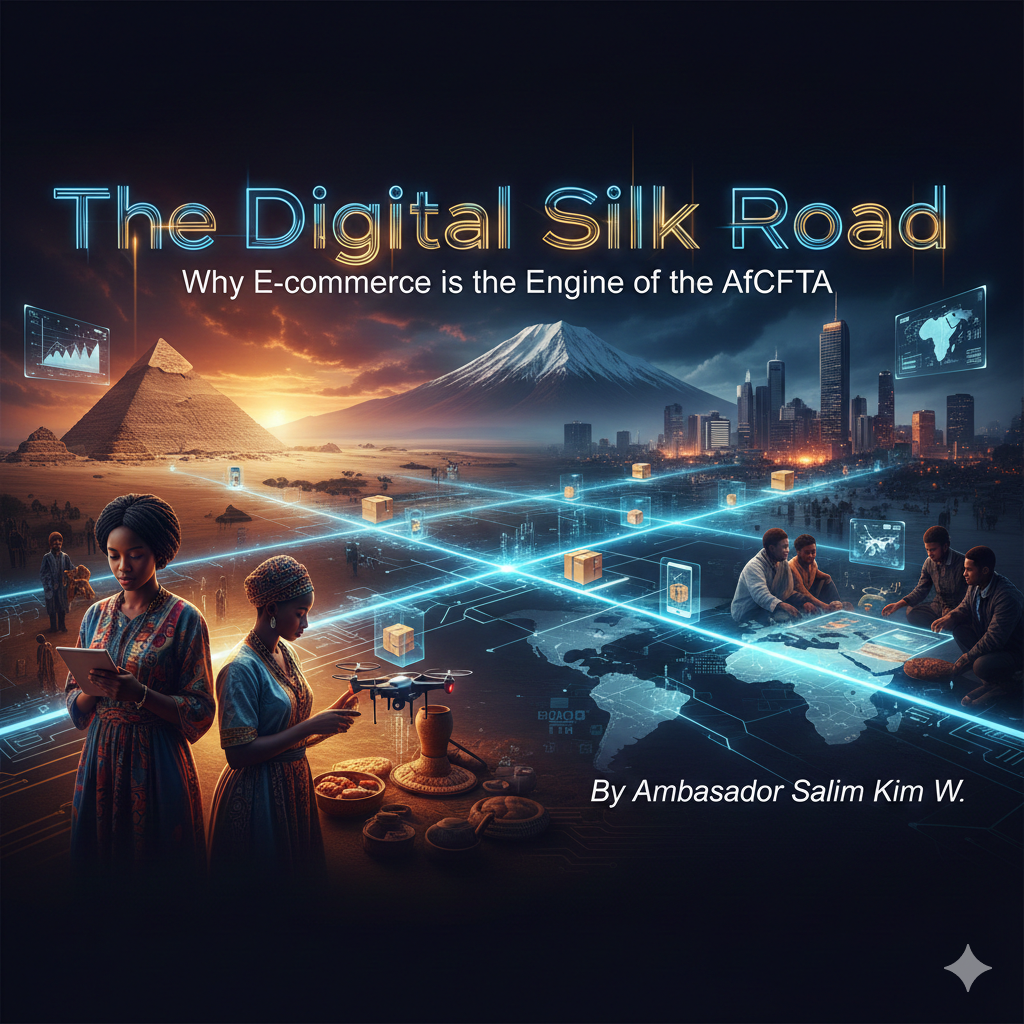
The Digital Silk Road: Why E-commerce is the Engine of the AfCFTA

  • Blog
  • January 12, 2026

By Ambassador Salim Kim W

The African Continental Free Trade Area (AfCFTA) is Africa’s crowning jewel, a colossal promise to unify 1.3 billion people and create a $3.4 trillion market. Now in its sixth year since inception, with its nascent Protocol on Digital Trade ratified in February 2025, the AfCFTA stands at a crossroads.

Turning this vast potential into tangible prosperity for the ordinary citizen depends entirely on who gets to trade and how they trade. The reality is that success will not be driven by giant corporations, but by millions of Micro, Small, and Medium-sized Enterprises (SMEs). These businesses, which employ over 80% of the continent’s workforce and are often led by ambitious women and youth, are the true architects of Africa’s economic future.

To reach every corner of the continent, from a craft cooperative in Kampala to a spice merchant in Accra, we must prioritize the creation of a "Digital Silk Road": a seamless, cross-border e-commerce ecosystem.

The Untapped Opportunity: Democratizing Trade

E-commerce is not a niche luxury; it is the fundamental tool for democratizing trade. For African SMEs, the transition to digital cross-border trade offers three revolutionary opportunities:

Market Access on Demand: Expanding physically into new markets requires prohibitively high capital and complex regulatory navigation. Digital platforms dissolve these barriers. A coffee farmer in Rwanda can now bypass layers of intermediaries to sell roasted beans directly to a consumer in Cairo. With the AfCFTA operational, intra-African trade could surge by 45%, injecting $450 billion into the continent’s GDP by 2035.

Inclusivity and Transparency: Digital platforms favor agility over scale. They provide rural enterprises with transparent pricing and traceable logistics. In South Africa, SME exports under AfCFTA rose 18% in the first half of 2025 alone, with e-commerce leading the charge in fashion and agro-processing.

Data-Driven Export: E-commerce generates real-time data on consumer preferences. This "new currency of trade" allows producers to pivot product lines and manage inventory efficiently. The protocol’s emphasis on cross-border data flows could unlock $180 billion in digital trade by 2030.

Comparison of Trade Models

Feature

Traditional Trade

Digital Silk Road (E-commerce)

Primary Actors

Large Corporations/Conglomerates

SMEs, Youth, and Women Entrepreneurs

Market Entry

High CapEx (Physical presence)

Low CapEx (Digital storefronts)

Reach

Urban hubs and major ports

Direct to rural and regional consumers

Documentation

Physical/Paper-based (Slow)

Digital/Automated (Real-time)

Payment

Complex FX/Letters of Credit

Instant Mobile/PAPSS Transfers

Digital Tollgates: The Critical Challenges

Despite this immense potential, the road remains littered with "digital tollgates" that threaten to relegate SMEs to the sidelines:

Payment Fragmentation and Currency Volatility: While the AfCFTA addresses currency settlement, the lack of instant, affordable digital payment systems is a crippling constraint. Cross-border transactions still grapple with fees averaging 7.5%. A seller in Nigeria receiving payment in Ghanaian Cedi faces delays and conversion processes that eat into thin profit margins.

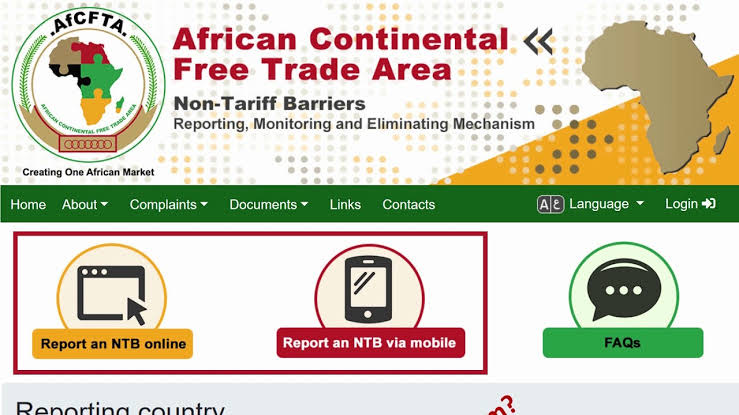
Non-Tariff Barriers (NTBs) and Logistics: Red tape, inconsistent customs valuations, and arbitrary inspections inflate export costs by 15-20%. Furthermore, the "last-mile" delivery of a small package remains unaffordable. Poor road networks and conflict zones can stretch delivery times to 21 days, compared to just four in Asia.

The Digital Divide: Only 43% of Africans have reliable internet access. We cannot ask a rural entrepreneur to manage digital inventory if they lack basic connectivity or the digital literacy required to handle customer service.

Regulatory Misalignment and Trust: Disparate data protection laws and consumer rights regulations create high compliance costs. Low consumer trust due to scams and inadequate protection frameworks further undermines the market.

Policy Implications: AfCFTA’s Digital Mandate

To truly harness the power of e-commerce, African governments, through their National Implementation Committees and the AfCFTA Secretariat, must act with urgency. We must strengthen the Digital Trade Protocol against such hurdles through the following actions:

1. Rapid Implementation of the Digital Trade Protocol

We must move from paper to practice by harmonizing cybercrime laws and standardizing digital authentication. This includes creating a continental digital single window, a one-stop portal for declarations to slash clearance times by 50%.

2. Invest in Last-Mile Logistics and "Groupage."

Governments must partner with the private sector to invest in regional fulfillment centers. We should encourage the "groupage" model, where SMEs pool shipments to cut logistics costs by up to 30%, moving small packages as efficiently as bulk goods.

3. Accelerate Digital Payments Integration

The Pan-African Payment and Settlement System (PAPSS) must be leveraged to support micro-transactions. We need simplified payment gateways that integrate with local mobile money systems (like M-Pesa and MTN), making payments instant and secure for every seller.

4. Skills, Capacity, and Inclusivity

We must embed digital trade education into national SME support programs. Training on platform use, digital marketing, and Rules of Origin is essential. Furthermore, policies must specifically target women-led SMEs, who comprise 40% of Africa’s micro-enterprises, through gender-focused trade finance and anti-harassment protocols.

Recommendations: Addressing the "digital tollgates".

1. Unified Digital Standards & "Single Windows."

To eliminate the 15-20% cost overhead caused by non-tariff barriers (NTBs), governments must move toward a paperless, automated trading environment.

  • Establish National Digital Single Windows: Implement a one-stop digital portal for all export documentation, customs declarations, and certificates of origin.
  • Adopt the UNCITRAL Model Law (MLETR): Legally recognize electronic transferable records (e-bills of lading, digital invoices) to ensure that digital trade documents have the same legal standing as paper.
  • Harmonize Data Privacy Laws: Align national data protection regulations with the AU Data Policy Framework to allow the free but secure flow of business data across borders.

2. Infrastructure for "Last-Mile" Efficiency

Digital orders are only as good as the physical delivery. Policy must focus on making small-parcel logistics affordable.

  • SME "Groupage" Incentives: Offer tax rebates for logistics firms that provide "groupage" services, pooling small lot shipments from multiple small vendors into single containers to reduce shipping costs by up to 30%.
  • Regional Fulfillment Hubs: Create "bonded warehouses" or digital trade zones at major borders where SMEs can store inventory closer to their target markets, reducing delivery times from weeks to days.
  • Universal Broadband Access: Subsidize "last-mile" internet connectivity for rural agro-processors and artisans, aiming for the AU goal of universal affordable access by 2030.

3. Financial Integration & Payment Interoperability

The high cost of cross-border payments (averaging 7.5%) is a direct tax on SME profits.

  • Mandatory PAPSS Integration: Require all commercial banks and mobile money operators to integrate with the Pan-African Payment and Settlement System (PAPSS). This allows a trader in Kenya to receive KES while the buyer in Nigeria pays in NGN, instantly and at low cost.
  • Digital Micro-Escrow Services: Develop legal frameworks for digital escrow services that hold funds until a delivery is confirmed, building trust between buyers and sellers who have never met.

4. Inclusive Digital Capacity Building

Policies must ensure that technology does not widen the inequality gap.

  • Gender-Sensitive Trade Finance: Set aside a percentage of AfCFTA-linked trade finance for women-led SMEs, specifically for the adoption of digital tools (e.g., e-commerce website hosting or digital marketing).
  • National Digital Trade Academies: Embed practical e-commerce modules covering digital branding, international SEO, and AfCFTA Rules of Origin into national vocational training programs.
  • E-Commerce "Corridors": Pilot "Green Lanes" for low-value e-commerce parcels (e.g., under $200) with simplified customs clearance, or simplified trade regimes (STRs) and zero tariff duties to encourage high-volume, low-value retail trade.

Conclusion: Paving the Way for the Digital Silk Road

The AfCFTA is designed to unite us economically, but e-commerce is the vehicle that delivers that vision to the homes of every citizen. As we enter 2026, a pivotal year for the protocol’s rollout,t we must remember that the digital revolution’s success hinges on empowering the smallest players.

Ambassador Salim Kim Walusimbi is an AfCFTA Trade Advisor, Trade Diplomat, and a thought leader on African economic integration and sustainable trade.

Share This News

Comment

Do you want to get more information about us?