



• admindesk@icoyacaafrica.org
News Photo

Maximizing the Potentials of the Guided Trade Initiative: A Strategic Roadmap for East Africa

  • Blog
  • January 27, 2026

By Ambassador Salim Kim W

The African Continental Free Trade Area (AfCFTA) is no longer a distant diplomatic ambition, but it is a living, breathing laboratory for African prosperity. At the heart of this transformation is the Guided Trade Initiative (GTI), a pilot program designed to break the "business as usual" cycle by facilitating real-time commercial transactions between ready member states. As we move through 2026, the East African Community (EAC) stands at a pivotal junction. With its deep integration history and diversified economies, East Africa is uniquely positioned to transition from a regional powerhouse to a continental leader.

The Pulse of the GTI: Current Activities and Trade Volumes

The GTI was launched to test the operational, legal, and customs frameworks of the AfCFTA. Initially involving a handful of pioneers, the initiative has now expanded. As of mid-2025, over 39 countries are participating at various stages, with approximately 10 to 12 nations, including East African giants like Kenya, Rwanda, and Tanzania, actively conducting commercially meaningful trade.

GTI Volumes and Success Stories

To fully appreciate the momentum of the Guided Trade Initiative (GTI), one must look beyond diplomatic rhetoric to the actual movement of shipping containers across the continent. As of January 2026, the GTI has evolved into the "engine room" of the AfCFTA, serving as a real-world laboratory for stress-testing trade protocols. The East African Community (EAC) has emerged as a frontrunner in this transition, with Kenya, Rwanda, and Uganda moving aggressively from signing ceremonies to commercially meaningful transactions.

Early trade under the GTI has been symbolic yet significant. Notable transactions include:

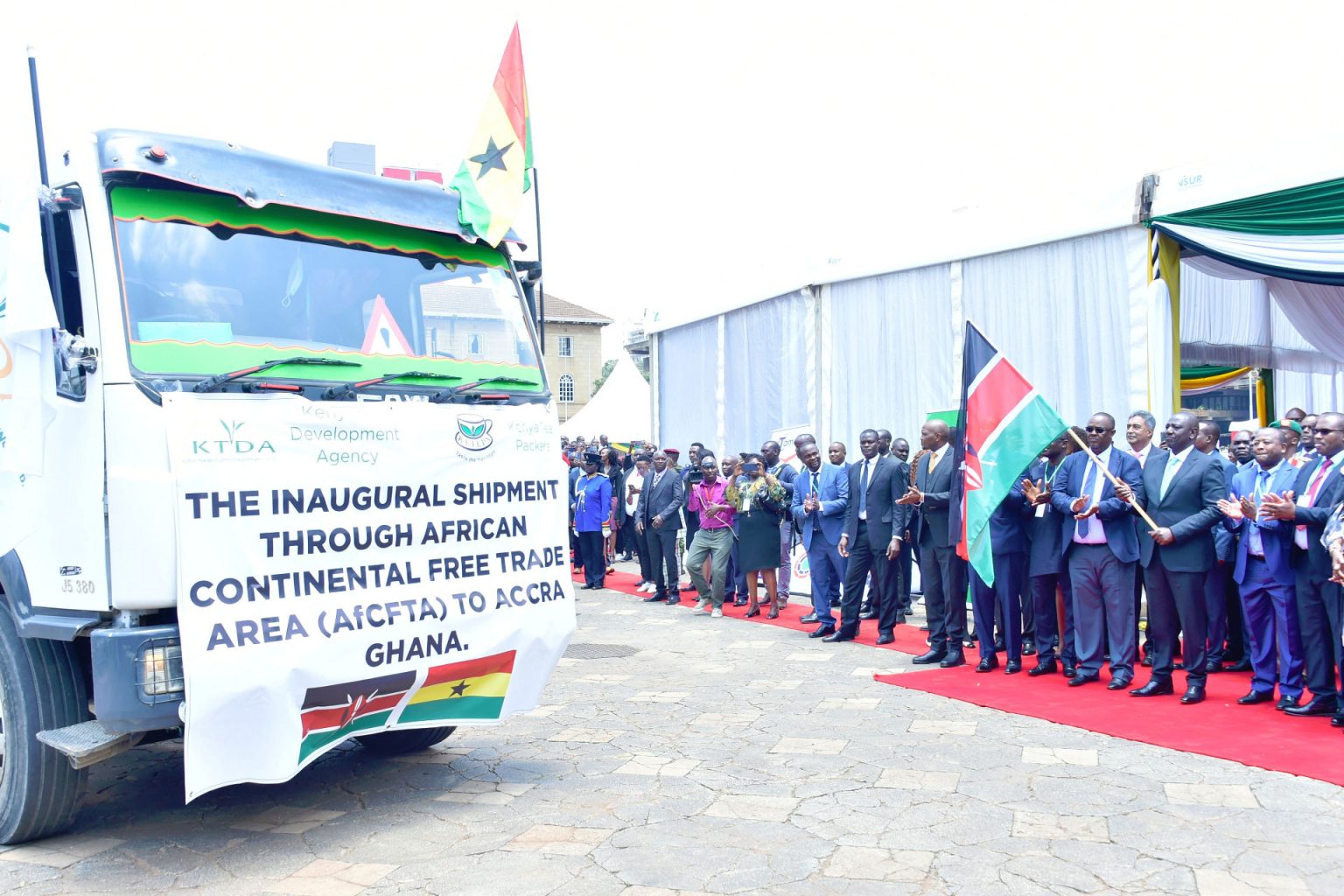
Kenya has distinguished itself as the "Regional Industrial Vanguard" of the region, shattering the myth that African trade is limited to raw commodities. A landmark success occurred when Associated Battery Manufacturers (ABM) shipped AfCFTA-certified car batteries to Ghana, with consignments valued at approximately $60,000 per container. This move was strategic; it proved that Kenyan industrial standards are compatible with West African requirements, allowing exporters to bypass the 35% duty previously levied on non-African batteries. Furthermore, by utilizing the AfCFTA E-Tariff Book, Kenya has successfully exported processed tea to Ghana, significantly reducing landed costs and allowing East African blends to outcompete global giants from Sri Lanka and India.

Rwanda has carved out a niche as the "Specialty Produce Pioneer," leveraging the GTI to position itself as a premium agro-processing hub. A standout success is Igire Coffee, a women-led enterprise that successfully broke into the Ghanaian market with processed Arabica coffee. Rwanda’s success is rooted in logistical innovation; the government piloted a Consolidated Cargo Strategy, allowing multiple SMEs to pool their products into single containers to achieve economies of scale. Combined with a strategic partnership with Rwanda Air, which offers a preferential cargo rate of $1 per kg for AfCFTA shipments exceeding one ton, Rwanda has effectively neutralized the "logistics tax" that often hinders small-scale exporters.

Uganda, acting as the "Regional Trade Integration Connector," has focused its efforts on building the structural and legal backbone necessary for long-term sustainability. In December 2024, the nation launched an ambitious 10-year National Implementation Strategy aimed at driving a tenfold growth in its economy through AfCFTA trade. To solve the "Landlocked Penalty," Uganda is engaging in "Corridor Diplomacy," co-investing in the Standard Gauge Railway (SGR) extension and oil pipeline infrastructure with Kenya. These efforts are expected to reduce time-to-market for Ugandan exports by 30%, creating a clear path for their surging exports of milk powder and Mount Elgon coffee to lucrative markets in North Africa, such as Egypt and Tunisia.

The true "volume" generated by these pioneers lies not just in the $9.3 billion in trade recorded in mid-2025, but in the institutional data harvested. Through the GTI, Kenya validated "chemical integration" as a legitimate form of substantial transformation under the Rules of Origin. Rwanda demonstrated that SME consolidation is the key to distant market entry, while Uganda proved that infrastructure integration is a mandatory prerequisite for landlocked competitiveness. Together, these nations are providing the blueprint for the rest of the continent to follow.

GTI Performance Snapshot (2023–2025)

Country

Primary GTI Product

Key Destination

Avg. Volume Growth (Q2 2025)

Kenya

Batteries & Processed Tea

Ghana, Egypt

+45%

Rwanda

Processed Coffee & Chili

Ghana, Mauritius

+38%

Uganda

Dairy & Coffee (Pilot)

Kenya, Ghana

+22% (Infrastructure Phase)

In the second quarter of 2025, trade between East African countries and the rest of Africa expanded by 42.9%, reaching approximately $9.3 billion. While these numbers represent a fraction of total potential, the true "volume" lies in the institutional experience gained testing the AfCFTA E-Tariff Book and the Rules of Origin (RoO) manual in real-world ports.

Navigating the Headwinds: Challenges Faced by Early Adopters

The journey has not been without turbulence. To truly understand the "teething" problems of the Guided Trade Initiative (GTI), we must look beyond the policy papers into the actual cargo holds and border posts where this trade happens. As an early participant in these discussions, I have seen that the "turbulence" is often found in the gap between continental law and local reality, as elaborated below:

1. Customs Cognitive Dissonance: The "Policy-to-Port" Gap

While the AfCFTA Secretariat in Accra and national ministries are fully aligned, the frontline customs officer at a remote border post often relies on legacy systems.

The Problem of "Dual Systems": Many early adopters had to manage AfCFTA rules alongside existing Regional Economic Community (REC) rules (like EAC or ECOWAS). Officers, unsure which took precedence, frequently defaulted to the higher, non-preferential "Most Favored Nation" (MFN) rates to avoid revenue leakage.

The "Paperwork Paradox": Even with the AfCFTA E-Tariff Book, technical glitches or lack of high-speed internet at border crossings meant that digital certificates could not always be verified in real-time, leading to trucks sitting idle for days, defeating the purpose of "guided" trade.

2. The Logistics Tax: The High Cost of Distance

In Africa, the cost of moving a container from the port to a city 500km inland can be higher than the cost of shipping that same container from China to the African coast.

The Infrastructure Deficit: Early adopters found that while tariffs were reduced to 0%, the "hidden costs"—fuel surcharges, unofficial roadblocks, and lack of return-cargo (empty trucks returning from a delivery)—added a 40% to 75% markup on the final price.

The Land-linked Penalty: For countries like Uganda or Rwanda, reliance on the ports of Mombasa or Dar es Salaam means their GTI success is partially tied to the efficiency of their neighbors' infrastructure, creating a dependency that individual national policy cannot always solve.

3. Regulatory Gaps and "Standards Protectionism."

Even when the tariff is zero, a product can be stopped by Sanitary and Phytosanitary (SPS) measures or Technical Barriers to Trade (TBT).

Standardization Stalemate: A batch of processed Kenyan juice may be certified by the Kenya Bureau of Standards (KEBS), but an importer in a different region might demand a local certification that takes weeks to acquire.

Protectionism in Disguise: Some nations, fearing a surge of cheaper imports, have used "quality inspections" as a tool to slow down trade under the GTI, effectively replacing high tariffs with high-walled regulations.

GTI: The "Early Adopter" Scorecard (2023–2025)

The following table highlights the specific hurdles encountered during the initial pilot phase:

Challenge Category

Specific "Teething" Issue

Real-World Impact

Institutional

Overlap with RECs (EAC, SADC, etc.)

Confusion over which Rules of Origin apply.

Financial

Currency Conversion Costs

Loss of 3-5% value when converting through USD/Euro.

Logistics

Fragmented Trucking Networks

Inability to track goods "Last Mile" across borders.

Technical

RoO Verification

Delays in confirming "Value Addition" for complex goods.

East Africa’s Competitive Edge: Leveraging the Five Priority Sectors

The GTI’s 2023 focus on services provides a golden opportunity for East Africa. Below is a detailed look at how the region's competitive advantages align with the five priority service areas:

Priority Sector

East African Strategic Advantage

Key Opportunity for Growth

Tourism

World-class wildlife (Kenya/Tanzania) and mountain gorillas (Rwanda/Uganda).

Developing "Multi-Country Circuit" visas to market Africa as a single destination.

Transport

The Northern and Central Corridors: Ethiopian Airlines' continental dominance.

Integrating cold-chain logistics to move perishables across the continent within 24 hours.

Business Services

A burgeoning tech hub in Nairobi ("Silicon Savannah") and Kigali’s ease-of-doing-business.

Exporting professional services (legal, accounting, and IT) to West and North Africa.

Communication

High mobile money penetration (M-Pesa, MTN) and subsea cable connectivity.

Leading the roll-out of the Pan-African Payment and Settlement System (PAPSS).

Financial Services

Robust banking sectors in Kenya and Mauritius with cross-border footprints.

Providing trade finance tailored for SMEs looking to enter the GTI.

Strategic Recommendations for the EAC

To move from participation to dominance, EAC member states must adopt a more aggressive, coordinated posture:

Harmonize beyond the REC: While the EAC is well-integrated, it must ensure its regional standards (like the EAC Quality Marks) are fully aligned with the AfCFTA’s continental requirements to avoid "double-standardization" hurdles.

Aggressive SME Onboarding: The GTI should not be for "Big Industry" alone. Governments must provide technical assistance to SMEs to navigate the Rules of Origin Manual, ensuring that small-scale coffee roasters or textile weavers can export duty-free.

Digital Integration: Deploying the AfCFTA E-Tariff Book is mandatory. Member states should digitize their entire customs chain to reduce human error and eliminate the "corruption tax" at border crossings.

Incentivize Value Addition: Instead of exporting raw tea or minerals, East African nations should use the GTI to export "Made in Africa" finished goods, reaping the higher margins that come with processing.

Conclusion

The Guided Trade Initiative is the bridge between the promise of a single market and the reality of a prosperous continent. For East Africa, the initiative is not just an invitation to trade; it is a call to innovate. By leveraging our leadership in services and manufacturing, and by collectively tackling the logistical and administrative bottlenecks, we can ensure that "Made in East Africa" becomes a household staple from Cairo to Cape Town.

Share This News

Comment

Do you want to get more information about us?